
Monroe Township Directory Collections
Monroe Township is a township, not an incorporated city, and Williamstown is its principal postal and census-designated community. That distinction matters on the historical shelf. The strongest verified Monroe Township city directory source is a Gloucester County volume, broad enough to include rural households and Williamstown entries. Other titles are useful leads, but their exact Williamstown pages and a complete local run have not been verified. Ask for an exact title and year before treating a county directory as coverage for a particular household.
| Collection | Years | Where Held | Access |
|---|---|---|---|
| The Farm Journal Directory of Gloucester County, Wilmer Atkinson Company | 1913 | New Jersey State Library Digital Collections; GCHS may hold print or microfilm | Free digital PDF at the State Library |
| Gloucester County directory lead | 1860 | Allen County Public Library and city-directory collections; check GCHS and FamilySearch catalogs | Lead only, direct official scan not located |
| Howe's Salem and Gloucester County directory | 1890-1891 | Library finding aid; confirm with GCHS, State Library, or FamilySearch catalog | Title verified, local pages not verified |
| Boyd's Salem and Gloucester County directory | 1893-1894 | Library finding aid; check GCHS catalog | Historical lead, exact Monroe coverage unverified |
| Plain Dealer microfilm and local newspaper material | Run not stated | Monroe Township Historical Society, GCHS, and library resources | Appointment or catalog inquiry |
The table deliberately does not claim a complete Polk, telephone, or criss-cross run. No official source established one for Monroe Township. The practical fallback is to ask the Free Public Library of Monroe Township, GCHS, the New Jersey State Library, or the Library of Congress for a specific title, date, and format.
Monroe Township's 1913 Directory
The digitized 1913 Farm Journal book is a county directory rather than a narrow municipal volume. Its publisher was the Wilmer Atkinson Company of Philadelphia, and the alphabetic entries mix town residents, farms, glass workers, stores, county officials, and families. That county-wide design is helpful for Monroe Township because a household might be described by Williamstown, a rural route, a crossroads, or a nearby community instead of a modern municipal label.
The New Jersey State Library's 1913 Farm Journal Directory item is the source for this digitized Monroe Township historical view.
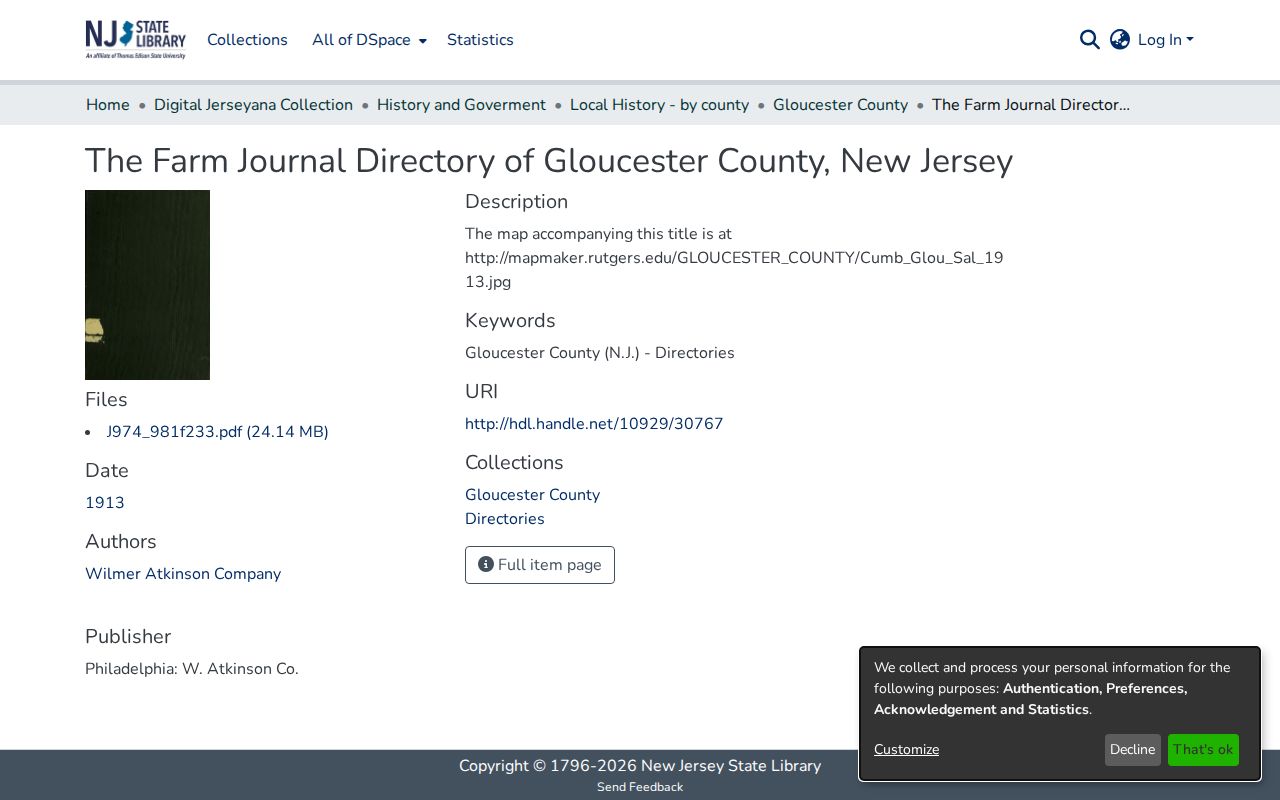
Use the book's introductory matter and key before assigning meaning to a mark in an entry. The volume can supply a surname, family relationship, historic trade, tenure clue, route, street, or map reference, but it remains a 1913 publication and should not be read as a present-day list.
Note: A name absent from that printed volume may reflect its scope, spelling, or collection practice rather than a person's absence from Monroe Township.
Reading Monroe Township Directory Entries
A useful entry inventory separates what is printed from what is inferred. In the Farm Journal volume, a selected household head may have an uppercase surname, given name or initials, a spouse in parentheses, a child count, a historic trade, and an address or rural-route clue. The entry may also show acreage, farm use, an O/T status mark, and a map or home code. It can connect a family to a place and year, but it cannot establish current residence or legal title.
| Headword | Surname, given name, initials, suffix, or relationship wording. |
|---|---|
| Family clue | Spouse in parentheses, child count, widow wording, or “son of” and “dau. of” relationships. |
| Historic activity | Farm, glass work, storekeeping, carpentry, medical practice, or another printed activity clue. |
| Tenure and land | “O” for owner, “T” as the volume's non-owner notation, “H&L” for house and lot, acreage, or farm-use wording. |
| Place clue | Street number, rural route, crossroads, community name, or an H/R map-home reference. |
- Criss-cross directory
- A later directory arranged by street or address rather than alphabetically by name. A complete Monroe Township run has not been verified, so request a specific volume before relying on one.
- Householder index
- An index centered on the household head. It can help separate related people with the same surname, but it may omit other residents.
- Abbreviation key
- The front-matter legend that defines shorthand such as O, T, H&L, Ch, R1, and R2. Copy or photograph the key with the entry.
Williamstown Labels in Monroe Directories
Williamstown is the main postal identity in Monroe Township, but it is not the only local label a researcher may meet. Downer, Cross Keys, Radix, Cecil, New Brooklyn, and Victory Lakes can appear in older or modern material. A rural route or farm description may disappear after subdivision. Match the city-directory wording with the legal municipality, county, address, and later parcel evidence instead of forcing every historical label into a modern street-number form.
This geography is also a guardrail against the common Monroe mix-up. New Jersey has another Monroe Township in Middlesex County. When a catalog, court, or archive search offers a municipality choice, select Monroe Township in Gloucester County and keep Williamstown as a separate postal clue. A Woodbury or Clayton mailing address can identify the county office holding the material, not the family address in the historical entry.
Monroe City Directory Reference Rooms
The Free Public Library of Monroe Township at 713 Marsha Avenue is the local starting point for a shelf check. The township booklet reports public computers, printing, fax, copying, notary service, and a certified librarian for reference questions. Ask staff to search the catalog and LOGIN shared-library catalog for Williamstown, Monroe Township, Gloucester County, telephone books, yearbooks, local newspapers, obituaries, and county histories. Interlibrary loan can help when an item is held elsewhere.
For county-scale material, the Gloucester County Historical Society library at 17 Hunter Street in Woodbury holds local newspapers, unrecorded deeds and surveys, family papers, church and cemetery material, and a large genealogy collection. Its reported non-member admission is $5. If travel is not possible, its research request asks for one ancestor, a residence, relatives, dates or places, and a precise question; the listed charge is $27 for members or $30 for non-members, including up to five copies and postage.
Gloucester County Historical Society's library and collections information documents this county repository for Monroe Township city-directory research.
Bring the surname variants, approximate years, community label, and a concise research question. That gives staff enough to check newspapers, books, maps, or an unrecorded record without assuming a directory volume exists.
Plain Dealer and ScanPro
The Monroe Township Historical Society supplies a local bridge when the book shelf has a gap. The township's 2025 booklet identifies the society's Reading Room, Hall Street Little School, and Ireland Hofer House, and reports a microfilm reader/digitizer with the Williamstown Plain Dealer collection. Its volunteer model makes a scheduled research appointment the sensible route. Newspaper notices can test a date, name, sale, obituary, civic event, or address reference found in a 1913 Williamstown entry.
The Reading Room dates to 1878, Hall Street Little School to 1887, and the Ireland Hofer House originated around 1800. Those landmarks add community context without turning a directory entry into proof. For family-history, veteran, or former-classmate research, pair a newspaper fact with a census, deed, cemetery, or probate record before drawing a conclusion.
Note: The booklet reports the microfilm resource but does not publish a complete newspaper or city-directory year list.
Trace Monroe Households Through Directories
Tracing a household works best as a sequence of dated records. Start with the full printed name and place clue, then preserve the details that distinguish that family from a same-name neighbor. A spouse, child count, route, historic trade, map code, or O/T status notation may be the second anchor needed to keep two families apart. The title year is not necessarily the date every fact was collected, so compare rather than assume a move.
- Record the full name, spouse, children, place clue, route, tenure mark, and map code from the 1913 entry.
- Search the 1860, Howe's 1890-1891, and Boyd's 1893-1894 leads by exact title, then confirm whether the requested volume actually covers Williamstown or Monroe Township.
- Ask for reverse or criss-cross material only by known title and year. No complete local run has been confirmed.
- Pair the directory evidence with federal census years 1900, 1910, 1920, 1930, 1940, and 1950, recognizing that a census is a one-day count.
- Use deed, probate, cemetery, church, and newspaper evidence to account for a change in address, household, or tenure.
For a later person-specific check, use the official records in the Monroe Township resident lookup rather than treating a historical directory as evidence of a current address. The most useful result is often a documented transition, not a forced answer to why a name vanished.
Monroe Directory Dates and Gaps
The known timeline has clear milestones and clear limits. Gloucester County was incorporated in 1686, and Monroe Township was formed on March 3, 1859 from Washington Township while the area was still part of Camden County. Identified directory leads are an 1860 Gloucester County directory, Howe's 1890-1891 title, Boyd's 1893-1894 title, and the 1913 Farm Journal volume. The first and last printed years for a Monroe-specific book were not verified.
- 1686: Gloucester County's record history begins, long before Monroe Township formed.
- 1859: Monroe Township forms from Washington Township.
- 1860, 1890-1891, and 1893-1894: identified county-directory leads require volume-level confirmation.
- 1913: the Farm Journal Gloucester County directory provides the strongest verified digital household source.
No official courthouse fire, flood, or local loss event was found in the inspected sources. The safer explanation for a missing year is distributed custody: County Clerk books, GCHS material, State Archives microfilm, library catalogs, and Historical Society newspaper reels each cover different parts of the trail.
State Archives Directory Fallback
When the local catalog cannot supply a volume, the New Jersey State Archives is the principal official historical fallback. Its research room at 225 West State Street in Trenton holds vital, deed, mortgage, will, surrogate, court, military, naturalization, and newspaper material, with an online catalog, microfilm, mail research, and a recommended appointment. The Archives also points researchers toward historical vital indexes, county deed microfilm through 1900, and other collections that can test a household clue from an historic book.
The New Jersey State Archives genealogical collections search is the source for this Monroe Township archival fallback.
Archives material is strongest when the request names the county, township, date range, record type, and the exact question. A catalog hit or index entry is a lead to the underlying source, not a substitute for reading the original record or its available image.
Monroe Directory Research Boundaries
Historical city directories are published snapshots with spelling mistakes, collection limits, and shorthand. O/T status marks in the 1913 volume are clues to how the entry was labeled, not a title determination. A census, deed, tax card, map, or grave record answers a different question and may conflict for ordinary reasons such as a later move, delayed deed recording, or a different mailing address.
Use the collections for family history, local history, estate or heir research, veteran history, and reconnecting with a documented past community. Respect the privacy of living people and verify a modern claim with the office that maintains the relevant record.